Mostrando postagens com marcador investment. Mostrar todas as postagens

segunda-feira, 30 de outubro de 2017

Report on European Union investments in Brazil

Apex, the Brazilian export agency, has published a thorough report on EU investments in Brazil.


You may check it here


'via Blog this'

segunda-feira, 21 de abril de 2014

Brazil's low productivity - Comments on The Economist's article


The Economist has published an interesting article about Brazil's low productivity. Specifically, on how it has been kept low for the last 50 years.


The 50-year snooze

I could endorse it almost word for word. I would like to copy it here and highlight the best parts in bold, but I see that this would be pointless.

Instead, I shall make some remarks on the dozens of comments left by Brazilians and foreigner alike.


i) Brazilian reader's English language skills are sub par

   Many of the Brazilians  made grammar mistakes and had difficulties getting their point across.

*My English skill are also not perfect.

ii) Brazilian reader's  general written communication skills and argumentation are subpar

  Several comments relied heavily on crystallised expressions and commonplaces, for example: "complexo de vira-lata" (stray dog complex); Brazilian cursed colonial heritage; British/American arrogance; Brazilian good people exploited by the evil American empire, etc.

Several comments criticised The Economist simply for publishing an article "against" Brazil, and many other comments attacked readers who pointed out the need for modernisation in Brazilian labour laws, as if they were suggesting that Brazilian workers should be deprived of its rights.

Some of the comments are aggressive against the foreigners who live in Brazil and that agreed with the article's critics.

iii) Brazilian reader's have trouble with the use of data and objective argumentation

 Brazilians commenting the article seldom make use of data points, statistics, etc.

5 of the commentators who seemed Brazilians used wrong data. On the other hand, 2 of the commentator who seemed Brazilian used data correctly.

The other seemingly Brazilians used no figures to support their comments.

CONCLUSION

The very comments to the article seem to confirm that Brazilian workers are not as well educated and trained as their peers, at least regarding written communication and argumentation in the English language.

It is fair to assume that there are direct connections between educational level and productivity. Also, I would go as far as to assume that a population with good English language skills is probably better suited to compete with Europe and America in high technology fields. Thus, one could say that the main point of the article (Brazilian inferior productivity) is well supported by the evidence provided by the Brazilian commentators.

I should say that I know that the numbers are not statistically significant, that the sample is biased and that this is not a rigorous survey.

But please keep in mind that, in spite of the lack of statistic value, the comments are an intriguing source of information. Few Brazilians know English well enough to read The Economist (some pools mention a 5% English literacy rate). And even among this select group it was easy to spot mediocre skills.

It is OBVIOUS that Brazilians have a tremendous education and productivity problem.

When investing in Brazil, keep that in mind and try to invest in your team's training.


terça-feira, 15 de abril de 2014

Setting up Electronic Payment Platforms in Brazil


I got another article published at Alternative Emerging Investor. Please find it below. 

You may purchase this article and the full magazine at http://www.aeinvestor.com/ 


PAYMENT PLATFORMS IN BRAZIL

Many providers of international payment services have been seeking to enter the Brazilian market.  The companies, both big and small, operate mainly through websites and focus on the intermediation of payments for merchandise. Several of them also offer direct transference services, especially between individuals.
The Brazilian market is very particular, however, due to its high level of automation and to its very strict regulation.

Brazil has implemented quasi real time retail, interbank and forex payments infrastructures in the form of automated clearing houses, overseen by the Brazilian Central  Bank.

The direct participation in such clearing houses is heavily regulated and demands investments in risk mitigation and technical infrastructure. Brazilian Central Bank will also perform a very detailed authorization process before allowing any company to become a financial institution able to take part in the backbone of the Brazilian payment system.

Smaller companies in Brazil have been able to participate in the market by acting as Point of Sale (POS) operators, intermediating the relationship between a highly dispersed customer base and a relatively concentrated base of retail providers.

The scene for international payment providers, however, remains a little opaque.  A number of companies are starting to do business in Brazil, basing their operations in a proprietary base of clients located in one specific country.  For example, one company may specialize in bank transferences made between a Brazilian community in Portugal and another specific Portuguese community in São Paulo.

These payment solution companies (PSC) might be, in effect, creating a separate, private clearing house for their own payments. This would happen, for example, if the PSC waited for similar order to be transmitted from one country to the other (one person in Brazil who wants to send 100 USD to Portugal and one person in Portugal who wants to send the same value to Brazil), and then compensated the orders within the respective countries (by depositing the 100$ sent from Brazil directly to the bank account of the person who wanted to receive money from Portugal, for example).

This kind of informal clearing of deposits would be absolutely illegal, since it would be made outside of the Brazilian payment system administered by the Central Bank.

To further complicate things, though, one must consider that if the PSC acts exclusively as a point of sale terminal, receiving data from credit cards and transmitting them for clearance before officially endorsed financial institutions in Brazil, its activities would be subject to a much less strict regulation. On the other hand, these PSC should be prepared to aid the Brazilian sellers or consumers to obtain proper tax documentation regarding the transaction, since the receipts of payment generated electronically often do not contain all the details required by Brazilian authorities.

Finally, transactions that use virtual coins, such as Bitcoin, inter alia, are out of the scope of regulation of the Brazilian Central Bank and therefore might theoretically be performed by PSC companies, even if they are not registered as or acting on behalf of financial institutions in Brazil.

The conclusion is that the operation of foreign payment solutions web sites in Brazil might be subject to two or three very different sets of rules, depending on details about how the transactions are conducted. The operations must be carefully planned in order to avoid infringement of public policy regulations. Further regulatory development, especially regarding the use of virtual coins, are expected to take place soon.


This article has originally been published at the sixth installment of - Alternative Emerging Investor.

To subscribe or purchase this issue, please visitwww.aeinvestor.com, or contact Ms. Tiffany Swensonat tiffany@aeinvestor.com.


sexta-feira, 21 de fevereiro de 2014

New Brazilian investment guide - Brazilian Agency for promotion of exports


SEE ALSO:
How to incorporate a Brazilian company through foreign direct investment
List of documents for setting up a company in Brazil
Power of Attorney for setting up a company in Brazil

Apex, the Brazilian agency for promotion of exports, has published a new Investment Guide to Brazil.

The material is beautiful.  The agency in charge of the design did good work.

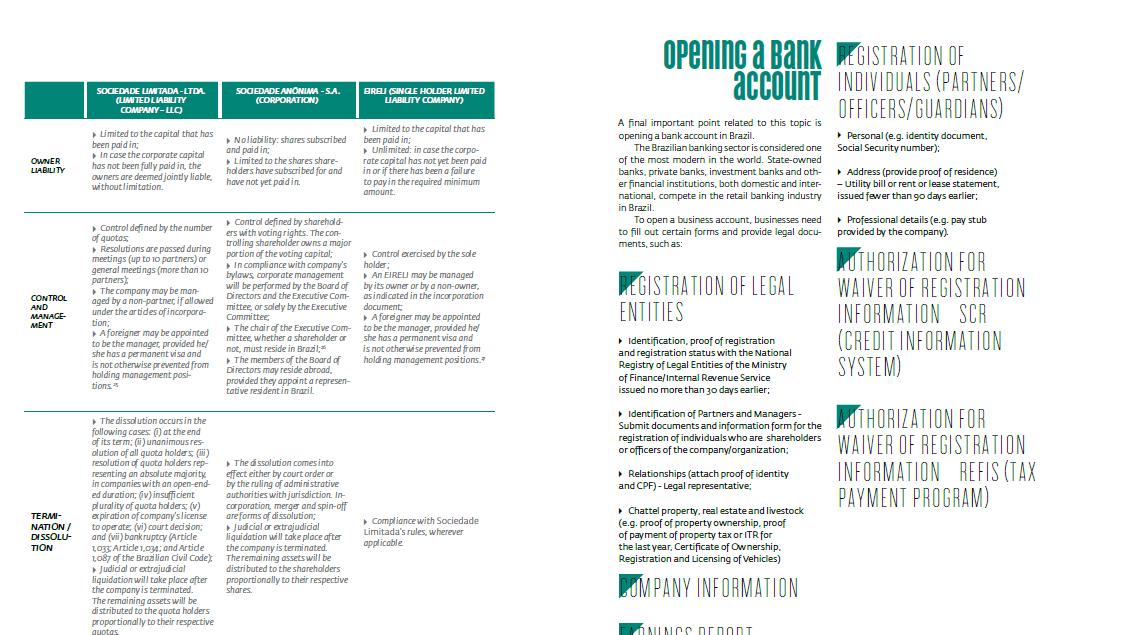
Compared to the earlier versions, I think that the legal part has  improved. It is more detailed and fairly close to reality.  The main slides regarding company incorporation are reproduced below.

The problem with this guide is excessive optimism and misleading information. For example, it lists as "Tax Incentives"some programs that are, in reality, very limited in scope.

It is also a publicity piece, with government agencies fighting to shine in their respective areas.  Brazilian Development Bank (BNDES) almost convinced me that obtaining loans is easy.

If you already know Brazil, I don't think the guide will add much. If you are a beginner, go for it (link below):

INVESTMENT GUIDE TO BRASIL 2014


segunda-feira, 28 de outubro de 2013

FDI moot and my amazing intern

My beloved UFMG's team, lead by my ex-intern, Ms. Maria Tereza, has been ranked first on the prestigious Foreign Direct Investment International Arbitration Moot competition, held last week in Frankfurt.

I have been one of the team's sponsors. I would love to say that I helped them to draft the memorials, but truth is I didn't.

I have given Maria Tereza some lessons about FDI policy when she was my intern, though. It's got to count for something.

I'm proud! My job is really rewarding sometimes.


http://fdimoot.org/2013.php

Top 25 Teams (Oral Rounds 1-4 and Memorials)
Rank/Points/Team Alias/University

*1
1528
Jennings
Federal University of Minas Gerais
2
1517
Fitzmaurice
New York University, School of Law
3
1511
Abraham
University of Warsaw
4
1509
Ajibola
St Petersburg State University
5
1501
Bravo
King's College London
6
1496
Sette
University of Buenos Aires
7
1477
Petren
Harvard Law School
8
1473
Cancado
University of Belgrade
9
1468
Jessup
National Law University,Jodhpur
10
1458
Rau
Lomonosov Moscow State University
11
1457
Xue
Georgetown University Law Center
12
1456
Elias
University Carlos III of Madrid
13
1451
Visscher
Gujarat National Law University
13
1451
Tanaka
Georg-August University of Goettingen
15
1437
Singh
Jagiellonian University
16
1433
Krylov
University of Ottawa
17
1431
Bengzon
De La Salle University - Far Eastern University
18
1427
Castro
Russian Academy of Justice
19
1421
Klaestad
University of the Cardinal Stefan Wyszynski
20
1419
Golunsky
Monash University
21
1416
Waldock
Judicial Research & Training Institute (JRTI)
22
1411
Lachs
Suffolk University Law School
23
1409
Alfaro
National Law University, Delhi
24
1402
Lauterpacht
Kyoto University
25
1393
Zoricic
University of Latvia
* Winner of the Baker & McKenzie Prize for the Highest Ranked Team as well as winner of Investor State Law Guide Prize for Highest Ranked Team 

segunda-feira, 15 de julho de 2013

Start-up Brazil Program


With the global technological innovation trend, the Brazilian government saw the need to help the competitiveness of Brazilian technology companies’ products, both domestically and internationally. To do so, it created several investment programs for such business segment, imposing few restrictions and considerable benefits.


The Brazilian government has created the Start-up Brazil, a program that aims to accelerate the development of technology-based companies, specifically software and services, by investing in new products.

It reveals a Brazilian trend in offering to the local and international market new innovative products and services, connecting our technological businesses with global ones, as well as seeks to build a partnership between the government and the private sector to foster the technology-based entrepreneurship.

The forecast of funds for investment is 40 million dollars and the companies that may apply are the ones with up to 3 years old. It shall be highlighted that 25% of the start-ups to be benefited by the program are international companies located in Brazil.

This initiative is part of the TI Maior, a Brazilian government program started in 2012 that sets several benefits for companies engaged in the technology industry.

The Paulista Innovation Fund (Fundo de Inovação Paulista), created in partnership with the Agency Develops SP and FINEP, follows the same line. This fund has from 60 million to 100 million and aims to invest in innovative companies that have authorization from the Securities Commission (Comissão de Valores Mobiliários - "CVM").

As well as the Government, the private sector also sought to create strategies to foment the development of technological creative industry. As an example of such initiative is the Criatec Fund, which seeks to invest in emerging and innovative companies and to obtain capital gain by investing long-term in early-stage companies (including zero stage), with innovative profile and a high return .

This fund still seeks to promote an integration of efforts among governments, universities and institutions of science and technology and the local business community, in order to maximize the technological development.

Furthermore, it is becoming more often in this business segment the intervention of Business Angels who are willing to inject capital in IT companies in embryonic stage. These are usually executives or successful companies that have accumulated sufficient resources to allocate part of them in investments.

As it turns out, there are a good number of initiatives both private and public to assist the development of start-ups in the IT sector, which is why investing in such companies in Brazil right now should be an option for those looking for building new business.

Sources:

segunda-feira, 20 de maio de 2013

How to send profits from Brazil to Europe


See also: 


This post cover the remittance of profits that have been obtained by a Brazilian company with foreign shareholders.

Foreign investments in Brazil are subject to registration with the Central Bank of Brazil (BACEN), and the information the investor provides becomes part of the Information System of the Central Bank (SISBACEN). This registry is a key requirement, without which the investor cannot remit the profits obtained in his operations in Brazil abroad, repatriate the capital or reinvest the profits.

After Law n. 9.249/2005, the profits earned and distributed from 01/01/1996 became exempt from income tax as well as from the supplementary income tax in Brazil. 

Therefore,  remittance of dividends abroad is exempt from income tax.

Dividends repatriation is allowed, at any time and without any kind of government authorization, as long as the balance sheet of the company is duly registered and the amount remitted is equivalent to the amount declared in the balance.

The financial institution managing the FX agreement may ask for a record of the shareholder`s meeting that decided upon the distribution of profits. This is due to compliance rules. Depending of the compliance analyst, it may accept a simple signed form, or it may request the records to the filed with the Commercial Registry. In this last case, the transaction may be delayed for one or two weeks.


sexta-feira, 17 de maio de 2013

Easier rules for work visas in Brazil


You may also want to see:

What changes:


1) Documents must be presented mainly electronically.
2) Most of translations (e.g. diplomas, graduation certificates) can be presented after the visa is required, and not before;
3) Foreigners may switch jobs while in Brazil in a much easier way. The visa is not cancelled when the worker change jobs, but automatically renewed.
4) Postgraduation students can come to Brazil in order to work during their vacation time (up to 90 days a year)

It is also expected that the analysis will be made much faster. 

Please notice that part of the old regulations still apply. The gates are still closed to workers without qualification and a Brazilian company must sponsor the visa request. 

The visa still has to be obtained before you come to Brazil!

Nevertheless, a change for the better. 


sexta-feira, 1 de fevereiro de 2013

Visa options for investors in Brazil


One of the questions I receive the most from my clients want to invest in Brazil is on the possibility of obtaining a visa for partners, directors and managers of their company.

Basically, in Brazil there are 3 visas that relate to business:


1) For investments above 600,000.00 Brazilian Reais, the company has the right to appoint one foreigner as a director. This foreigner will receive a visa automatically. Each 600,000.00 allow for one director.


2) For investments above 150,000.00 Brazilian Reais, one investor may obtain a Visa, as long as he can prove that the company will bring a relevant social impact to the area where it is located, or that the company will generate jobs for Brazilians. Again, each investor must bring at least 150,000.00 (lower investments may grant a visa if the social impact is proven to be outstanding).

The social impact is evaluated according to the business plan presented along with the visa request. The main criterion is always the creation of jobs. But the use of new technology and te empowerment of local communities are also important.

A relevant social impact would be, for instance, the installation of a factory in a very poor region. If the business plan is solid, the social impact can be easily accessed by the Brazilian government.

Some of my clients, for example, invested only 100,000.00 BRL and obtained a visa. In one specific case, the new company brought new design for wood furniture, and would employ a few workers in the production of such furniture. The business was also located in a poor region of a big city in the Northeast of Brazil.
  
3) Finally, a foreigner may obtain a work visa if a Brazilian company hires him for a permanent job. Possessing a bachelor or graduate diploma makes the granting of the visa more probable. The Brazilian company must have 2 Brazilian employees in similar functions to every foreigner it hires for that function.

Should you or your company have any problems or questions concerning visas in your business in Brazil, do not hesitate to contact us for further information.

quarta-feira, 9 de janeiro de 2013

Gerdau case: exemption of taxation over foreign subsidiaries

 Since 2001, all Brazilian matrix companies must pay income tax over the profits of its foreign subsidiaries yearly, even if such profits are not properly distributed as dividends. 

That has led the Brazilian Revenue Service to hunt down several Brazilian companies that maintained subsidiaries abroad, and tax them. 

However, the situation remained unclear in many instances. For example: what would happen when the country where the subsidiary was located maintained a non double taxation agreement with Brazil?

Or, what if there were many layers of shell companies and subsidiaries?

Today, there are literally billions of dollars at stake, as the Brazilian Supreme Court analyzes the constitutionality of such taxation. More on that here.

However, a very good piece of news came up this week: an administrative court has ruled in favor of Gerdau, in a case related to Gerdau's subsidiary in Spain (which maintains a NDT with Brazil). 

By the way, Gerdau is a leading producer of long steel in the Americas and one of the largest suppliers of special steel in the world.

I'm hoping this decision will tip the scale in favor of the Brazilian companies. After all, it has discussed many of the arguments that will be judged by the Supreme Court in the future. 

A detailed description of the case, in Portuguese, may be found here. 

quarta-feira, 2 de janeiro de 2013

Brazilian (and Chinese) Business Law Trends for 2013.

This post, as many others, has been inspired by Dan Harris' China Law Blog.  The link to the original post is also at the bottom.

Interestingly, some China trends he mentioned are the opposite of the Brazilian legal trends on the same subjects. It invites comparison:


1. China will step up even further its crackdown on foreigners in China violating its visa/immigration laws. 
1. Brazil is set to make immigration easier, specially for specialized workers. Legal changes are expected to take place in March, 2013.

2. China will increase its efforts to root out and shut down illegal and unregistered foreign businesses. 
2. Brazil is not seeing any special movement on this area.

3. China will increase its tax collection efforts.
3. Brazil is already super effective in tax collection. What we are about to see, though, is an increase in the control and taxation of international service and software sales. The Brazilian Revenue Service has just put the "Siscoserv" in place. This system controls every international service transaction in the country. Personally, I see it as a harbinger of tax increase. After all, the government does not have much left to tax.

4. China: Litigation is increasing.
4. Brazil: Arbitration is increasing. The Brazilian courts are broken, and everybody knows that. Arbitration is the only safe harbor for international investors. 

Other trends that were not mentioned for China, but are relevant for Brazil:

5. Infrastructure regulation will remain uncertain, as the government sorts out how to fix the legal mess it made in 2012.

6. Regulatory compliance for consumer goods (toys, medicines, electronics) will soar. 
  As more and more imported products flow to the Brazilian economy, the pressure from the Brazilian industries will generate more and more non-tariff barriers to imports. It has just begun. 

What do you think?


China's Business Law Trends for 2013. Booorrring. | China Law Blog

segunda-feira, 10 de dezembro de 2012

Border control in Brazil


Today the blog is launching a new weekly column. We will be counting on the invaluable contribution from Ms. Gringa da Silva, a foreigner who lives in Brazil and has some sharp-witted remarks to make about the country. 

The law part of the Brazilian Law Blog will remain under my responsibility. But Ms. Gringa's comments will certainly add some flavor to the usual FDI, IOF, Taxation, Importation and other legal conundrums that we all have learned to love. 

Enjoy!


___________

Welcome to Brazil - Bem-vindo ao Brasil 


Ah, the first post. It's always so exciting to begin something new.

So, you are about to arrive in Brazil, good for you. Have you got your paperwork in order? Got your vaccinations in order? Is your passport pretty and neat and without marks? Did you fill out your customs declaration form correctly?

You are about to enter the realm of The Brazilian Border (insert Twilight Zone music here), which is controlled by the Federal Police of Brazil. (We will be revisiting them many times as time goes on, so we'll just leave the summaries for later.)

Good things to know:

1) It is illegal to be rude to a bureaucrat in Brazil.
2) You can be denied entry to the country for being inconvenient.
3) No one (you actually need to speak English) speaks English.
4) No one at the border cares who you are; though they might care what your football team is.
5) It will take a while, so make friends in the line, stay calm and whatever you do, don't be iconvenient.
6) The line will be long, the instructions will be confusing, and the pressure of your bladder will be annoying.

You cannot escape the visa requirements, the paperwork, the possible fees incurred and customs regulations while entering Brazil and if you try, you might be denied entry.

Don't be an idiot by attempting to buy your way in or insult your way in, unless you fancy spending time in jail and a swift deportation with a possible clause prohibiting your return.

Know what is needed before you land. Have it all ready and at hand, and for heavens sake, if your mother packed a salami in your luggage (they have salami in Brazil, mom) tell them about it, don't try to import it illegally.

The Federal Police have no obligation to let you in and the particular flavour of bureaucrat you are about to meet is just looking for reasons to say the dreaded words: Falta! (error/ offence/ irregular/ not allowed)

So, when you find yourself all smelly from that billion hour plane flight, full of the delicious food you were served on the plane and dreaming of a bathroom that is larger than a carry-on bag, stay cool, be calm and for heaven's sake, be polite.

On the caipirinha scale, the border crossing rates a 1.


Until next week, yours in the spirit of cachaça,

Ms. Gringa da Silva


All rights reserved © 2012 by Ms. Gringa da Silva (http://msgringadasilva.orgfree.com/)