Mostrando postagens com marcador Brazilian. Mostrar todas as postagens

quarta-feira, 21 de maio de 2014

Practical problems with the new Brazilian internet law (Marco Civil da Internet) - 1

I'm starting a series on Brazilian new Internet Law. 

Please also read: 

Mandatory changes to Internet User Agreements in Brazil


I hope the image ilustrating the post helps explaining what this law really is about: censorhip (and taxes, but we will get there later).

I will start with some conversations I had just after the law came into force. A longer and more detailed article will follow. 


CONVERSATION 1.


Hi Adler - 

Hi hope this finds you well.  I'd like to call an old favor. 

As you may remember, I work for an American National Entity that is very concerned with Internet privacy and internet communications. We have a website available to Brazilians.

We are trying to get a grasp of how the new Marco Civil will impact our business and what changes we need to make (if any). I'm not sure if this falls within your area of expertise. If not, could you recommend someone that we could speak with?

Nick F.


---------

Nick,

You know you can always count on me.

I'm studying the new law right now. I'm focusing on its conflict of law provisions (mandatory application of Brazilian law in some cases) and in its tax provisions. 

We can talk about that if you want. I will also publish a blog post on the next days. 


Regards, 

Adler

---------


Adler,

+ our legal counsell operative, Matt.

Thanks for getting back to me. 

Although we are interested in all aspects of the law (including tax provisions), what we are most concerned about right now (correct me if I'm wrong, Matt) is how this law impacts the collection, use, storage, and process of personal data for which the law seems to state a website needs a users consent. 

Depending on the interpretation of this text, it could make it very difficult for websites to operate in Brazil. Is this something you have a grasp on? Maybe the better question is, does anybody in Brazil have a grasp on the meaning of this? 

FYI - We still do not have a Brazilian entity, but it is something we are considering in the near future. 

Thanks again,


N.F.
-------------------------

Nick,

To be honest, I'm not quite sure. The law is terribly drafted. 

Article 7 institutes heavy limitations on the use of customer's information. 

Article 8 says that the exclusion of Brazilian courts is not allowed in "Internet contracts", but it is not clear if the use of arbitration would circumvent this prohibition. 

Finally, article 11 mandates the use of Brazilian law, basically whenever there is collection of cusomer's information. However, it is not clear if: 

i) arbitration would circumvent this; 
ii) the execution of a separate agreement, specially a commercial one, would be enough to allow for the use of a foreign law;
iii) if this has any practical application, since:

  a) it is not probable that Brazilian will choose local courts to sue foreign-based companies and web sites.  and
  b) Brazilian general conflict of law rules would indicate a different approach, and it is not clear which rule (the general ones or this one) will apply in a determined case


Also, the law mentions that registers of the use of the information by foreign applications must be maintained by local service providers in Brazil. I suppose this is aimed at big Telecom or phonecompanies that sells apps in Brazil, inter alia. 

But I'm not sure how this would translate to mass markets if you take the use of internet via desktops into account. 


I'm open to discuss this matter over the phone, without cost.  In case you feel you need a legal opinion, we can discuss that. 

May I publish this conversation in my blog, without mentioning your name? This would help a lot. 

Regards, 

Adler
-------------------------

Correct

We need to understand what qualifies as a "user" ?  Someone who merely "uses" or site without registering with an account, or someone who registers with our site only (where we can get an "agreement" to some extent)

We need to understand what PI is for such casual users, and for registered users.

We need to understand cookies on users.

But yes.  This law on its face seems difficult if not impossible to comply with.


Matt M.


sexta-feira, 21 de fevereiro de 2014

New Brazilian investment guide - Brazilian Agency for promotion of exports


SEE ALSO:
How to incorporate a Brazilian company through foreign direct investment
List of documents for setting up a company in Brazil
Power of Attorney for setting up a company in Brazil

Apex, the Brazilian agency for promotion of exports, has published a new Investment Guide to Brazil.

The material is beautiful.  The agency in charge of the design did good work.

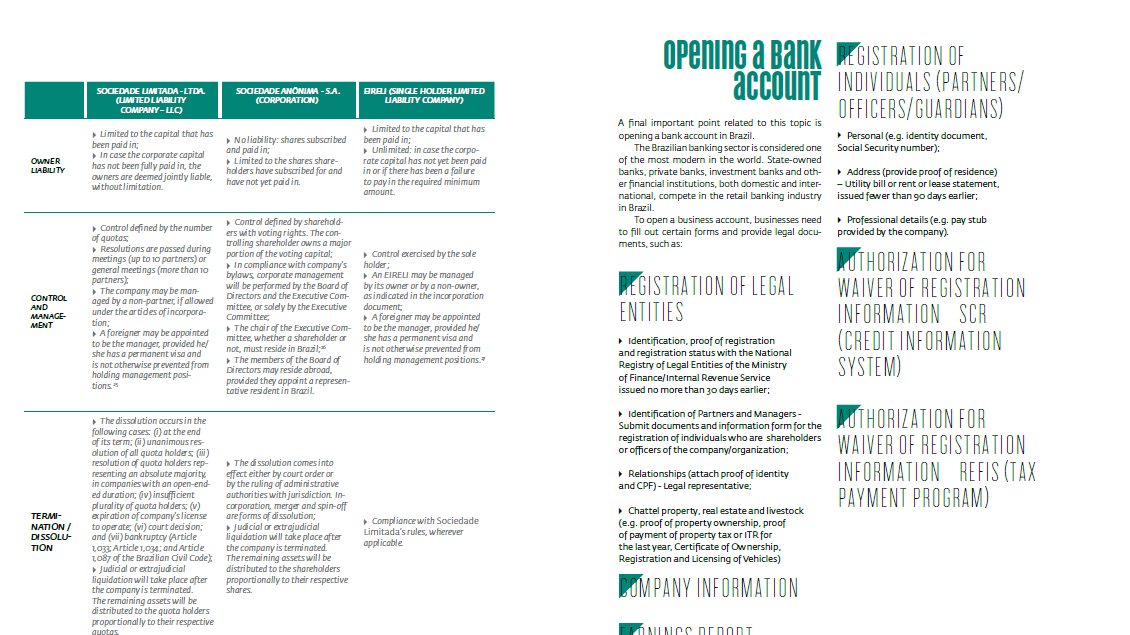
Compared to the earlier versions, I think that the legal part has  improved. It is more detailed and fairly close to reality.  The main slides regarding company incorporation are reproduced below.

The problem with this guide is excessive optimism and misleading information. For example, it lists as "Tax Incentives"some programs that are, in reality, very limited in scope.

It is also a publicity piece, with government agencies fighting to shine in their respective areas.  Brazilian Development Bank (BNDES) almost convinced me that obtaining loans is easy.

If you already know Brazil, I don't think the guide will add much. If you are a beginner, go for it (link below):

INVESTMENT GUIDE TO BRASIL 2014


quarta-feira, 14 de agosto de 2013

State intervention in Brazilian Contracts 1 - Consumer contracts

Today we start a series of posts regarding the State intervention in Contracts in Brazil. In this occasion we will discuss the consumer contracts and bring some concerns that foreign investors should have.

As already mentioned here in the blog, the Brazilian government has an annoying interventionist policy ,and this is specially true when  it comes to consumer contracts. 

Here we have a consumer code (Act nº 8.078/90) that overburdens the seller with all the onus of ´producing evidence (even if the evidence is favorable to the other party). So, be aware: if you are prosecuted, you will probably lose. Ther are special courts specialized in consumer issues, where the veredict is all but unpredictable. 

The consumer code also limits party's autonomy to choose forum for litigation. The consumer's residence has priority. 

Arbitration in consumer agreements is possible, but subject to restrictions.

In this context, if we were to analyze Brazilian contract law (regarding consumers) according to J. Adams and R. Bronsword categories, it would definitively fit the "Consumer-Welfarism" definition, since the brazilian consumer code puts the consumer as a weaker party in the contract.

It is important to stress that any final consumer is protected by consumer law. This means that a huge industry purchasing heavy machinery can claim the same legal protection granted to senior citizens who purchase a tv set. 

Importers and distributor are co-responsible, along with the manufacturer, for consumer liabilities. Thus, you must take care to provide your distributor in Brazil with the adequate tools and resources to solve any technical problem, or to provide replacements.

I will write more about it soon.

terça-feira, 4 de junho de 2013

Brazilian Family Reunion Visa x Permanent Visa for Retired Persons

See also:


I usually get many requests for visas for my clients: work visas, visas for foreign investors. In general, when one of my foreign clients incorporate a company in Brazil, he is also interested in making an application for a permanent visa. I recently received a visa application request that was not so common: an investor was interested in bringing one of his parents to Brazil. Look at the email I received:


“Dear Adler,
I'm living in Brazil for about five years. My wife is Brazilian and I have opened my own business here. The only problem is that I want to bring my father to live with me. He is getting too older and has difficulty living alone. How can I get a permanent visa for him?”


Thor's question is very interesting. Currently there are two ways to bring his father to Brazil with a permanent visa. The first is the so-called Family Reunion Visa. The second is the Permanent Visa for Retired Persons.

Basically, the differences between these two types of visas are the following: for the Family Reunion Visa, it is necessary to prove that his father are dependents of Thor. As for the Permanent Visa for Retired Persons, it is necessary to prove that his father has a retirement pension able to supply his basic needs in Brazil.

The proof of financial dependency is done through various ways. It is necessary to prove the Thor's father is unable to provide his own needs .This can be done, for example, by providing proof that Thor transfered to his father some money every month to help him financially.

The retirement visa, on the other hand, has a more objective criterion. Thor's father must prove that with his retirement pension he is able to transfer at least R$ 6,000 brazilian reais monthly to a bank account in Brazil.

See also:


sexta-feira, 31 de maio de 2013

ARBITRATION IN BRAZIL IS LESS SAFE NOW - Part 2

Just the other day I was posting about the attacks and criticism against arbitration in Brazil.

I mentioned that I was even considering forbidding my clients to arbitrate in Brazil.

Yesterday, I got new reasons to be concerned. A respected legal publication in Brazil has published two articles with severe criticism against arbitration in the capital markets.

I'm not sure if this means that the publication is only creating a buzz around the topic, or if this is a real legal trend developing in the Brazilian academia.

But I don't like to direction it is taking. I'm cautious.

You can check the stories here (in Portuguese):

Especialista critica arbitragem em mercado de capitais

Sigilo é obstáculo à formação jurisprudência arbitral


What do you think about it?


You may check part and part 1

terça-feira, 28 de maio de 2013

Intellectual property and 'fair use' under Brazilian Law


See also:


Frequently I am asked by my clients on matters related to the protection of trademarks, brands, company names, software contracts and other issues of intellectual property in Brazil. Recently a client asked me about the so-called "fair use" in Brazil, and if he could make references to other brands in his product without permission of the owner.

Many of my clients are familiar with the concept of "fair use", but fact is that there is no express provision of this concept in the brazilian rules of intellectual property protection, although some laws that make indirect references to this concept.


For example, Brazil is a member of the TRIPS Agreement (Agreement on Trade-Related Aspects of Intellectual Property Rights), which provides that:

Article 17
Members may provide limited exceptions to the rights conferred by a trademark, such as fair use of descriptive terms, provided that such exceptions take account of the legitimate interests of the owner of the trademark and of third parties.

The protection of brands in Brazil is also regulated by National Act No. 9.279 of 1996, which says:

Article 132. The trademark holder may not:
IV - prevent the mention of the brand in speeches, scientific or literary or any other publication, as long as there are no commercial connotation and no damage to the brand's distinctive character.

The Brazilian copyright law (National Act No. 9.610 of 1998, article 46) and the Brazilian software law (National Act No. 9.609 of 1998, article 6) also have some rules that resemble the American concept of fair use, most of them related to the non-commercial, artistic or cultural use.

Thus, one can notice that, although that Brazilian law does not expressly stipulate the concept of "fair use", there are in Brazil a number of possibilities of use of trademarks or brand names without violation of intellectual property rights.

Is there any reader who works with IP and would like to contribute to the discussion?


See also: