Mostrando postagens com marcador agreement. Mostrar todas as postagens

sexta-feira, 27 de junho de 2014

Mandatory changes to Internet User Agreements in Brazil

Brazil internet law has come into effect. Just the other day.  You may find the bilingual text here (from 
The Geneva Internet Platform).

Any internet company, any company that distributes software or apps,  and basically any company that has a web page that can be used by Brazilians, will be forced to adapt its User Agreements and privacy policies to the new law. 

The government is expected to publish a decree detailing the expected changed. But, from the text of the bill, we can make some assumptions. 

This will be a very short list. You will find more detailed comments at http://www.privacylatam.com


i) Terms of Use offered to a broad public will automatically be subject to Brazilian consumer protection rules;
i.a) privacy protection rules shold always follow Brazilian law, whenever the access is made from Brazil (but not when a Brazilian access the website from abroad);
ii) It is mandatory to offer Brazilian forum as one of the options for litigation forum (it is not clear if this prevents arbitraitons, or if arbitration must be placed in Brazil);
iii) You can't sell user information to data collection companies or for publicity purposes, unless there is express and specific approval from the user;
iv) agreements shoul be made through special entities, detached from the main group, in order to avoid fines applicable to any company of the group;
v) sharing user's emails or other information with security agencies from other countries, without prior authorization from Brazilian courts, becomes illegal;
vi) permanent exclusion of all user's information should be allowed, upon request;
vii) companies must be ready to provide basic info on the user to criminal prosecutor, even in the absence of a court decision (the constitutionality of this provision is disbutable);
viii) user agreement must be written in easy and accessible language (it is not clear if it means clear Portuguese or if a clear English text will do). 


Please read my other posts on this matter:

Practical problems with the new Brazilian internet law (Marco Civil da Internet) - 1


I will keep you posted as the subject develops. 

segunda-feira, 21 de abril de 2014

Contractual implications of Brazilian imperfect adoption of CISG - Problems with China, inter alia

Two years ago, I wrote two brief posts about the adoption of the United Nations Convention on International Sale of Good (CISG) by Brazil (here and here).

Basically, I mentioned that Brazil needed only issue a presidential decree and CISG would become law.  I said:

 Presidential sanction in Brazil sometimes takes more than 20 years to be achieved. NY Convention on international arbitration took 50 years to be completely approved in Brazil, for instance.  Let's hope  CISG set a record the other way around.


Well, there has been much celebration lately regarding CISG in Brazil. But the hard fact is that the presidential decree is still missing.

I take this absence as a strong symbol of lack of political interest in the matter.

This kind of presidential decree is very simple. It is hard to understand how the Presidential Office would have overlooked such an important convention, when in the last two years dozens of international conventions of far less importance have been ratified.

Nevertheless, the Convention Secretariat lists Brazil as a member (check the list here).

This situation is potentially problematic because it may lead merchants to deduct that CISG is the applicable law for sale agreements with Brazil when, in practical terms, Brazilian courts will probably adopt the Brazilian civil code (or at least Brazilian conflict of law rules).

The situation is even more problematic when  it comes to Brazilian (arguably) major trade partner: China.

In my research about contracts within BRIC countries, (which I recommend you to read) I mentioned that:


3.1.1 Application of the CISG in China


China ratified the CISG in December, 1986. However, it has adopted a significant reservation to the text: it compromised to apply the CISG only if the other country involved in the transaction has also adopted the convention. (...) 

In consequence, in contracts between Brazil and China and between India and China that are brought upon Chinese courts there is a strong possibility that the applicable law will be deemed to be the Chinese internal legislation, especially the "Law on Contracts of the People's Republic of China of 1999" and the “General Principles of Civil Law of People's Republic of China’’. If this is not the wish of the parties, they must study the conflict of law rules applicable to the case and adopt preventive measures. 


Therefore, contracts between China and Brazil, at this moment, might fall in one of three categories: 

i) CISG is applicable (if courts in both countries rule that CISG is valid in Brazil, in spite of the lack of a presidential decree);

ii) CISG is deemed not applicable in Brazil, and thus CISG will also not be applicable in China, resulting in that conflict of law rules must be applied in order to verify the applicable law;

iii) Brazil rules CISG as part of the Brazilian law and China rules CISG as not part of the Brazilian law and, because of that, CISG would not be applicable according to Chinese law. Therefore, a serious and irreconcilable conflict of laws would be put in place.


I consider the situation as being too uncertain. Major trade partners could use a little more certainty in their contractual relationships. 

The same problem goes for any country that, like China, has adopted the safeguard of  Subparagraph (1)(b) of Article 1 of the CISG. 

Brazil, always making simple things complicated.


ADDITIONAL READING: 


segunda-feira, 25 de novembro de 2013

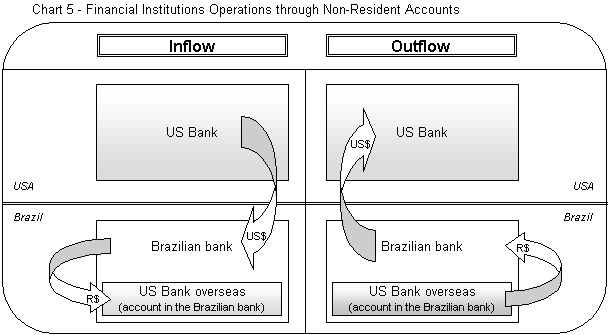
Getting money into your Brazilian company - a few common problems


See also: 


I have spent the last week struggling with Brazilian banks in order to get ahold of some investments/loans that my clients wired from abroad.

I often receive complaints from the readers, saying that "Brazilian banks have retained their money", or that "It is impossible to get money into Brazil".  More than one have asked me what would be the penalty for bringing the money in a bag (or in a car). They always ask about this last one in a theoretical way, but I sometimes sense that it has gotten way over platonic contemplation.

I know my way around the system, for sure. But, even for me, this kind of operation is always stressful. Everybody in the firms gets double coffee on money week.

The path, in theory, is not so difficult. Basically:

quarta-feira, 2 de janeiro de 2013

São Paulo Court allows purchase of rural land by foreigners


I'm adamant about the unconstitutionality of the restriction on the purchase of land by companies that are controlled by foreigners. 

Today, Valor Economico, a Brazilian newspaper, published an article stating that the São Paulo Court of Justice (similar to a State Court, or court of appeal) has ruled that a Brazilian company with a majority of its capital owned by foreigners can, indeed, purchase land. 

The company in question is a paper mill and, apparently, needed land to harvest trees. 

I congratulate Mr. Ricardo Quass Duarte, from  Trench, Rossi e Watanabe Law Firm, for this victory. 

Anyone needing more details about the case is welcome to contact me. 

A link to the original article follows below:


http://www.valor.com.br/brasil/2954596/tj-sp-autoriza-registro-de-terras-por-empresa-controlada-por-estrangeiro#ixzz2GqiUeZsS

TJ-SP autoriza registro de terras por empresa controlada por estrangeiro | Valor Econômico

segunda-feira, 19 de novembro de 2012

NEGOTIATION PATH IN THE BRAZILIAN MINING, ETHANOL & BIOFUEL MARKETS


In order to ensure a good workflow for the negotiations between Foreign buyers and Brazilian owners, I would like to explain in detail how negotiation in Brazil usually goes on.

A. First of all, one should know that the Brazilian Ethanol, Mining and Biofuel markets are very heated nowadays. Opportunities on those areas do not last long and probably most of them are alredy under negotiation, what gives the owners a good leverage.

In other words, they are not desperate for pleasing investors and are not very patient. In their view, if they wait for one specific investor they are losing many others. That is why they do not grant exclusive purchase rights until negotiations are very advanced (e.g. when investors are already doing extensive surveys at the site).

B. Another important information is that there are very important logistics problems in Brazil. Therefore, any mining deposits that are far from a port or railroad will demand the construction of a special pipeline or a private railroad (more details about that on my article about railroads in Brazil)

C. Due to the market’s conditions, any investor has to be really interested on traveling to Brazil.
First, to know the areas that are being negotiated and acquire a good perception of any logistics limitation.

Second, because e-mail and telephone negotiation normally do not go further. Big companies are pouring engineers and traders in Brazil, and the land owners feel inclined to deal with those who are already here.

D. The relationship between investors and sellers is usually not direct at the beginning. Owners prefer to have real state brokers attracting investors. Owners do not take part on initial negotiations and both owners and brokers disclose only superficial information in the early stages.

E. In order to have access to the seller personally and to receive full information about the opportunities, brokers usually demand a Letter of Intent (LOI0 for each specific opportunity and may request the physical presence of the investor in Brazil.

If the investor cannot come to Brazil, he shall appoint someone here with powers to negotiate in his behalf.

F. Once the meeting starts, information will be disclosed by the owner.

G. After deep discussion, investors shall decide if they want to proceed with visits and surveys. This normally requires a lump sum payment to the owner, in order to secure the business. Exclusivity rights to trade or purchase are usually granted at this stage.

H. After surveys, but before buying, investors would need a detailed Due Diligence of the Seller’s business. (That is, by the way, one of my specialties. Please send an email to adlermartins@gmail.com for more information about Due Diligence in Brazil).

I. After approval by investor’s lawyers, the site can finally be purchased.

If the investor follows the steps above, the contacts will certainly be more effective. Trust me, I know.